
Telling and talking
Our focus as a charity is very much around openness and making sure that everyone involved in the creation of a family through donor conception is aware and knows what they need to know.
Our focus as a charity is very much around openness and making sure that everyone involved in the creation of a family through donor conception is aware and knows what they need to know.
We do a lot of work helping parents build confidence in telling their children they were conceived with the help of a donor. We produce books and workshops and have a support network of families to give people the resources and services they need to be open. Similarly, it’s important that your close family members know that you donated. As a minimum we’d recommend that your partner and children are aware.
We don’t want donor conceived children to discover the fact of their origins in an unplanned way or after doing a home DNA test. Similarly, we don’t want your children or close family to discover the fact that you were a donor in an unplanned or unintended way. If your brother or cousin got an unexpected match on a DNA test it would be much better if they were able to think, “Ah, I wonder if this is a donor conceived person connecting with me,” instead of thinking, “This makes no sense, it must be a mistake.”
We have a range of books for children and that includes six versions for donors – called My Story, My Gift – to help you explain your donation to your own children in age appropriate language. Although the story is designed for young children aged 5-8 years, the book can also work for older children. You can use it as a framework for how to talk to other members of your family as it gives a structure and narrative as a starting point that can be adapted. We offer it as a support tool to give donors confidence in sharing the information and to encourage them to be more open.
If you are a clinic or egg or sperm bank and would like to order these books in bulk to give to your donors, please email sales@dcnetwork.org for more information about that, including the discount we can offer for orders of over 20 books to one address.
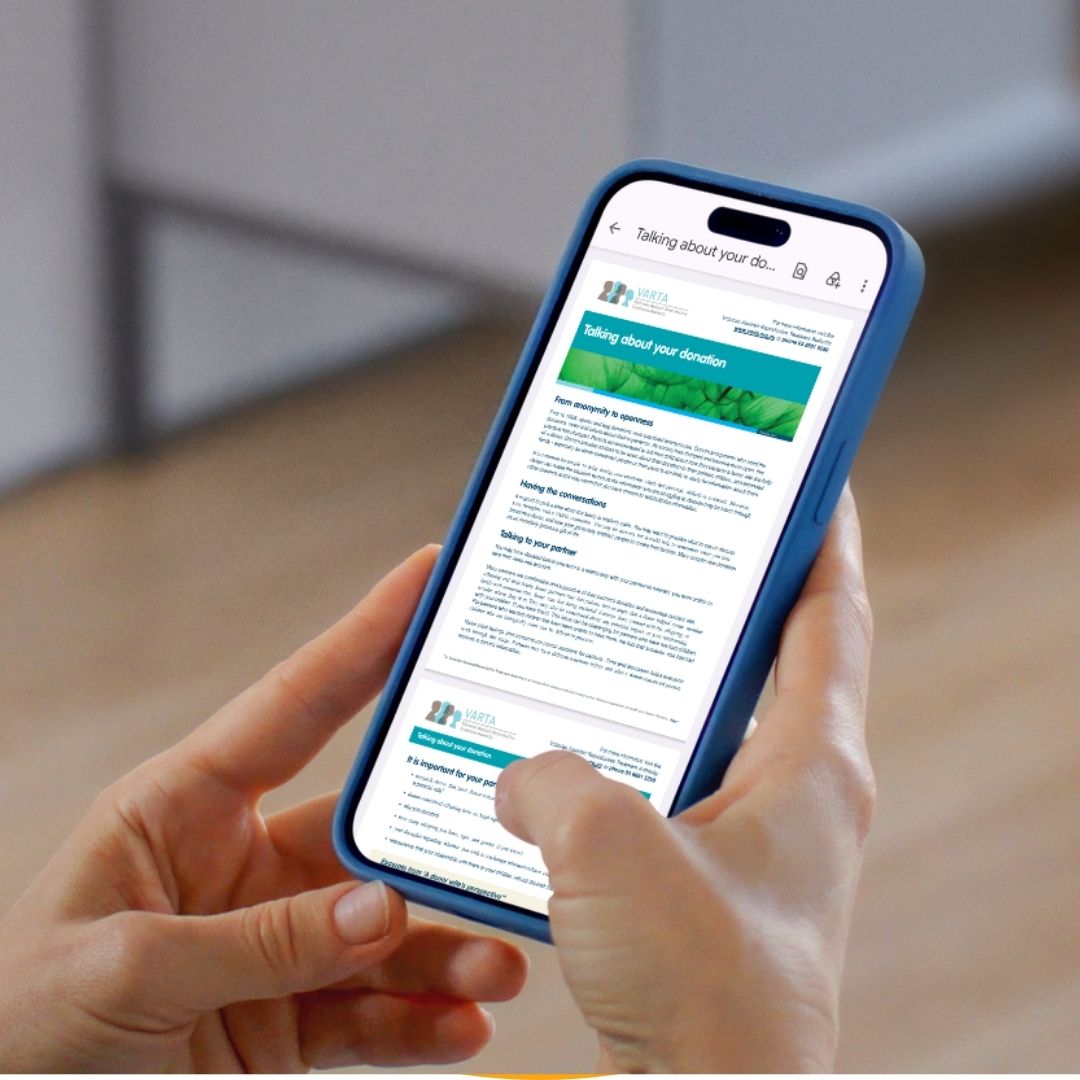
If you’re a donor, you may have questions about how to talk to your partner, children or other family members about your donation. VARTA (Victorian Assisted Reproductive Treatment Authority) has produced this information sheet to help donors think through these conversations and the implications of being open about their donation. It includes advice on talking to partners, children, parents and siblings, particularly as donor-conceived people and their parents may now be able to access information about the donor. Although the resource is based on the Victorian system, it offers useful guidance for any donor thinking about how and when to talk to their family.
The ‘Preparing for Contact’ section of our ‘Already a donor’ pages includes information about donation across different time periods, as well as useful research and studies to help you understand what to expect and prepare for possible contact.


